Friday, 1 June 2012

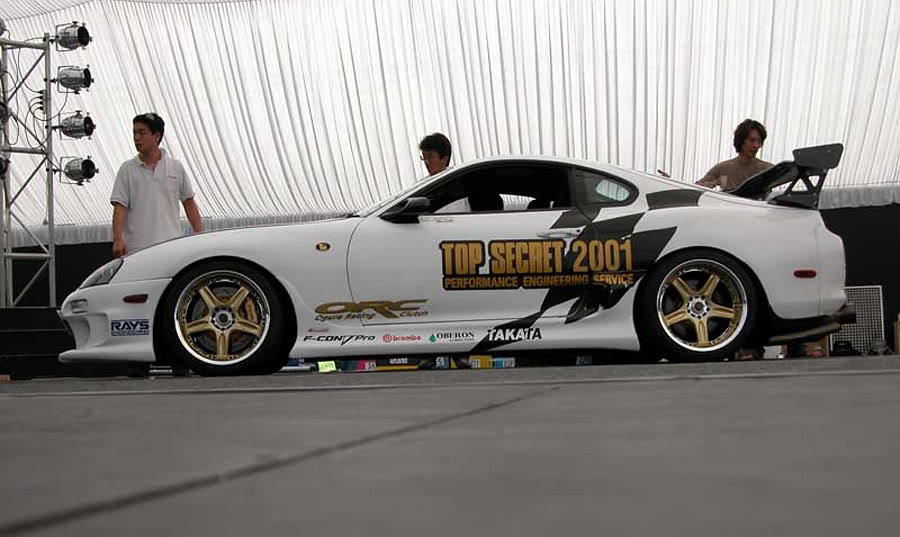
Some Supras just do it right...Mark IV (1992–2002)...


Toyota took a big leap in the direction of a more serious high-performance car. Again using subframe, suspension and drivetrain assemblies from the Z30 Soarer (Lexus SC300/400), test model pre-production started in December 1992 with 20 models, and official mass production began in April 1993. The new Supra was completely redesigned, with rounded body styling and featured two new engines: a naturally aspirated Toyota 2JZ-GE producing 220 hp (164 kW; 223 PS) at 5800 rpm and 210 lb·ft (280 N·m) at 4800 rpm of torque and a twin turbocharged Toyota 2JZ-GTE making 276 hp (206 kW; 280 PS) and 318 lb·ft (431 N·m) of torque for the Japanese version. For the export model (America/Europe) Toyota upgraded the Supra turbo's engine (smaller, steel wheeled turbochargers, bigger fuel injectors, etc.). This increased the power output to 320 hp (239 kW; 324 PS) at 5600 rpm and 315 lb·ft (427 N·m) at 4000 rpm. The turbocharged variant could achieve 0–60 mph in as low as 4.9 seconds (0–62: 5.2 sec.) and 1/4 mile (402 m) in 13.3 seconds at 109 mph (175 km/h).  The turbo version was tested to reach over 285 km/h (177 mph) all-stock, but the cars are restricted to just 180 km/h (112 mph) in Japan and 250 km/h (155 mph) elsewhere. European versions also had an air intake on the bonnet. Drag coefficient is .31 for the naturally aspirated models and .32 for the turbo models and N/A's with the rear spoiler.


The Mark IV Supra's twin turbos operated in sequential mode as opposed to parallel mode. Initially all of the exhaust is routed to the first turbine for reduced lag. This resulted in boost and enhanced torque as early as 1800 rpm, where it already had 300 lb·ft (410 N·m) of torque. Approaching 3500 rpm, some of the exhaust is routed to the second turbine for a "pre-boost" mode, although none of the compressor output is used by the engine at this point. Approaching 4000 rpm, the second turbo's output is used to augment the first turbo's output. As opposed to the parallel mode, the sequential turbos provides quicker low RPM response and increased high RPM boost. (The Mazda RX-7 Twin Turbo also uses a sequential turbo setup, while the Nissan Skyline GT-R, 300ZX Twin Turbo and the Mitsubishi VR4 Legnum and later model Galant used a parallel setup.) This high RPM boost was also aided with technology originally present in the 7M-GE's in the form of the Acoustic Control Induction System (ACIS) which is a way of managing the air compression pulses within the intake piping as to increase power.


For this generation, the Supra received a new 6-speed Getrag/Toyota V160 gearbox on the turbo models while the naturally aspirated models made do with a 5-speed manual W58, revised from the previous version. Each model was offered with a 4-speed automatic with manual shifting mode. Turbo models were equipped with larger brakes and tires than naturally aspirated models. All vehicles were equipped with 5-spoke aluminium alloy wheels and a space saver spare tire on a steel wheel to save weight and space. Additionally, there are other differences such as the differential, headlight assemblies, throttle body, oil cooler.


Toyota took measures to reduce the weight of the current model compared to the previous model. Aluminium was used for the hood, targa top (if so equipped), front crossmember, oil and transmission pans, and the suspension upper A-arms. Other measures included hollow carpet fibers, magnesium-alloy steering wheel, plastic gas tank and lid, gas injected rear spoiler, and a single pipe exhaust. Despite having more features such as dual airbags, traction control, larger brakes, wheels, tires, and an additional turbo, the car was at least 200 lb (91 kg) lighter than its predecessor. The base model with a manual transmission had a curb weight of 3,210 lb (1,460 kg). The Sport Roof added 40 lb (18 kg) while the automatic transmission added 55 lb (25 kg). It had a 51:49 (front:rear) weight distribution. The turbo model came in as 3,450 lb (1,560 kg) with the manual and the automatic added another 10 lb (4.5 kg). Weight distribution was 53% front/47% rear. On a side by side testing in Motor Trend's July 1993 issue, the Supra was heavier than the spartan Mazda RX-7, and aluminium-bodied Honda NSX, but weighed less than the Nissan 300ZX Twin Turbo and the AWD Mitsubishi 3000GT VR4.


For the 1996 model year in the U.S., the turbo model was only available with the automatic transmission due to OBD-II certification requirements. The targa roof was also made standard on all turbo models. For 1997, the manual transmission returned for the optional engine along with a redesign of the tail lights, headlights, front fascia, chromed wheels, and other minor changes such as the radio and steering wheel designs. All 1997 models included badges that said "Limited Edition 15th Anniversary". All turbo models came standard with the rear spoiler. Only minor updating was done for 1998. Along with a 3-spoke steering wheel and redesigned radio. The naturally aspirated engine was enhanced with VVT-i which raised the output by 5 hp (4 kW; 5 PS) and 10 ft·lbf (14 N·m) of torque. In Japan, the turbo engines were installed with VVT-i. The SZ-R model was also updated with the introduction of a six-speed Getrag V161 transmission, the same used for the twin-turbo RZ models.


The stock Mark IV Supra chassis has also proven an effective platform for roadracing, with several top 20 and top 10 One Lap Of America finishes in the SSGT1 class. Despite its curb weight, in 1994 the Mark IV managed a remarkable skidpad rating of 0.95 lateral g's (200 ft) or 0.98 lateral g's. (300 ft) The Mark IV Supra also featured a four-sensor four-channel track tuned ABS system with yaw control whereby each caliper is sensored and the brakes are controlled individually according to the speed, angle, and pitch of the approaching corner. This unique Formula One-inspired braking system allowed the Supra Turbo to record a 70 mph (113 km/h) -0 braking distance of 149 ft (45 m) the best braking performance of any production car tested in 1997 by Car and Driver magazine. This record was finally broken in 2004 by a PorscheCarrera GT, which does it in 145 ft (44 m) .


The US and UK market Supra featured bigger injectors, steel turbines and bigger inlet cam and had emissions in the range of 259 g/km CO2 despite the addition of Exhaust Gas Recirculation (EGR). The Japanese market Supra had CO2 emissions in the range of 224 g/km.

Some Supras just do it right...Mark III (1986–1992)..


In May 1986, Toyota was ready to release its next version of the Supra. The bonds between the Celica and the Supra were cut; they were now two completely different models. The Celica changed to front-wheel drive, while the Supra kept its rear-wheel-drive platform. Though the Mark II and Mark III had similar designs, the engine was updated to a more powerful 3.0 200 hp (149 kW) inline 6. Although only available in naturally aspirated trim in 1986.5, a turbocharged version of the engine was introduced in the 1987 model year. The Supra was now related mechanically to the Toyota Soarer for the Japanese market.


The new Mark III Supra engine, the Toyota 7M-GE, was the flagship engine of Toyota's arsenal. Both versions of the engine contained 4 valves per cylinder and dual overhead cams. The turbocharged 7M-GTE engine was Toyota's first distributor-less engine offered in the US which used coil packs sitting on the cam covers and a cam position sensor driven by the exhaust camshaft. It was equipped with a CT26 turbocharger and was rated at 230 hp (172 kW) at 5600 rpm while the naturally aspirated 7M-GE engine was rated at 200 hp (149 kW) at 6000 rpm. Further refinement on the turbo model increased power to 232 hp (173 kW) and 254 lb·ft (344 N·m) in 1989. This was mostly due to a redesign of the wastegate. All models used the same tire size of 225x60xR16 on 16x8 inch wheels. Spare tires were full-sized but on steel wheels.


Due to a large error in the factory head bolt torque specifications, all of these engines had severe problems with blown head gaskets. Toyota never issued a recall for any of the affected vehicles. The problem could be easily fixed by replacing the head gasket and torquing the head bolts to 75 lb·ft (102 N·m) of torque. However, due to the lack of a recall or appropriate service bulletin, the head gasket problem would recur if the gasket was replaced and the bolts were retorqued to the erroneous service manual specifications. With the head bolts torqued correctly, the engines were otherwise extremely durable.
The naturally aspirated came as standard issue with the W58 manual transmission. The turbo versions included the more robust R154 manual transmission. Both were available with the optional 4-speed A340E automatic transmission. The third-generation Supra represented a great deal of new technology. In 1986, options available for the Supra included 3-channel ABS and TEMS which gave the driver 2 settings which affected the damper rates; a third was automatically activated at WOT, hard braking, and high speed maneuvering. HKS also made a "TEMS Controller" to hack the system and activate it on the fly, though the controllers are now nearly impossible to find.


ACIS (Acoustic Controlled Induction System), a method of controlling air compression pulses inside the intake piping to increase power, was also a part of the 7M-GE's technological arsenal. All models were fitted with double wishbone suspension front and rear. A targa top was offered along with a metal power sliding sunroof (added in '91).

Friday, 18 May 2012

TOP SECRET LEGENDS...Nuff said..


The base car is 2001 Nismo N1 Super Taikyu GT-R that has been completely reworked by Top Secret. Some of the major stats include:
Top Speed - 198.4mph (320km) at 8500 RPM with HKS transmission (Max Power Mag reports 210mph max)Power - Dependent on setting, currently 728 HP / 488 ft/lbs for time attack setting. Peak 854hp Weight - 1300kg / 2860lbs (770lbs lighter than stock)
0-60: 3.1 seconds (est by Max Power Magazine)

                                    
This vehicle was built by the renowned Japanese tuning workshop Top Secret and has been used as a promo car for several years. It has spent very little time on the track as it has been used primarily for display purposes at motor shows, and has only been run at official racing events to prove the package. Everything is in perfect working order. This vehicle has had literally hundreds of thousands of dollars spent on it. One of the fastest and most well known Skylines in the world and a very rare find.
Performance: Has recorded a 9.6 second 1/4 mile on Yokohama 048 racing tyres. MAX POWER: 1000ps / 9000rpm. MAX TORQUE: 90kgm / 8000rpm.

One of the most famous cars made by Top Secret was this GT300. It's not powered by the 2JZ but gets its horsepower from the much lighter 3S-GTE engine. ‘Smokey' did this to improve the power to weight ratio and the balance of the car.
The capacity of the 3S-GTE engine has been increased thanks to a Garage Fukui Stroker kit and SPL pistons. The turbo of choice is the Trust T88 34D, giving the engine 710bhp at 8500rpm and 470lb-ft of torque at 7800rpm. Those are some impressive number considering it's ‘just' a four cylinder engine.


Top Secret knows how to build engines. They started with a bare SR20 block and enlarged the displacement with a HKS 2.2 liter kit. For the turbo they went with a modified HKS 3037PRO-s. A Tomei camshaft ensures that the throttle response is nice and fast. The exhaust manifold is a one off made by Top Secret. The engine pushes out 550ps
Cooling is also a major issue with drift cars; they always go sideways so it is very important to get as much cooling as possible. Top Secret went with a V-mount setup and used three electric fans. ARC provided the oil cooler and the triple core intercooler.
For the fuel system they went with SARD 1000cc injectors and fuel injector. Top Secret also added an extra fuel pump and fuel delivery pipe to the front of the car.


Smoky has been a busy man! This is the recently completed Top Secret R35 GT-R, wearing the new 2012 GT-R inspired front bumper and the signature gold color everyone knows and loves. The car made its first appearance at the 2010 R's Meeting this past weekend in Fuji Speedway, hinting that Top Secret has gotten serious about the R35.
The engine has been fitted with a pair of re-engineered stock IHI turbines which are modified and ported to flow more air and fitted with a 22% bigger turbine wheel. The built in wastegates are also enlarged and controlled by fast-acting GReddy actuators.  At 1.25 kgf of boost the motor manages to develop 700 HP with a massive 651 lb/ft punch of torque at 4,000 rpm.


The Top Secret Supra project is intended to present the Supra as the kind of supercar some feel Toyota should be selling. Its V12 powerplant is sourced from a Toyota Century (a Japanese market luxury sedan), and extra power beyond its stock 276 horses, many airflow aids have been added. These range from custom plenums and piping to dual HKS GT2540 turbochargers. All in all, the engine's output has been tuned somewhere north of 1,000 hp.


LEGEND 0-300 TOP SECRET SUPRA

RB26 with T88 turbo in a Top Secret Supra

CHRIS RADO’S 2500HP SUPRA...STREET CAR?!


The Mentalist sometimes remembered as Chris Rado has been creating secret plans to build his even more mental street car. Of course, for someone who pilots a 2000hp drag car and the his 1500hp time attack car, his meaning of street car is somewhat more than what you or I might even imagine. For Mr Radical, his ultimate street car is this Toyota Supra. Metal wide-body, custom wheels, custom brakes. And a twin turbo V8 producing 2500hp?!!!!!!!


Engine?! which one you ask? This is a 6.2 Toyota 3UR-FE V8 which can rev to 10,000 RPMs and handle up to 3.5 bar of boost. These engines is typically found in most late model Toyota Pick-ups mostly aimed to USA.


Brembo Italy worked in conjunction with Race Technologies here in the US to come up with this custom Brembo GT-R kit for our Supra. 15-inch rear calipers. Some people have smaller wheels than that!


Basic Details

-1994 Toyota Supra
-TRD prepped 2JZ-GTE
-Fully prepped and custom internals
-Turbonetics Y2K Hybrid turbo
-Spearco air-to-liquid intercooler
-Penske 8100 custom series front and rear coilovers
-HRE 3 Piece forged aluminum wheels: 18x10f, 18x14r
-Yokohama 265/35ZR18f and 345/30ZR18r tires
-Custom wide body (Pictured in concept sketch above) made of carbon fiber weave parts pulled from one off hand formed fabricated metal molds.
-Momo seats, steering wheel, shift knob, shift boot, e-brake boot, seat harness and pedals

NISMO & THE Z-TUNE R34...Whaa?!

Nismo originally designed the concept of the Z-tune in 2002 when Nissan was putting an end to the R34 Skyline production. The first Z-tune was built in 2003, using a used 2002 Skyline GT-R V-Spec II.


It was built with a concept RB26DETT 'Z1' engine. This engine was based on Nissan's Le Mans GT2 and GT500 racing experiences. As with the racing vehicles a strengthened engine block and stroked crankshaft were utilized. The engine was also bored. With the new displacement of 2.8L and upgraded turbo-chargers the Z1 produced 500 hp. The Z-Tune had a 0–60 mph time in 3.2 seconds and has a top speed of over 195 mph.


Nismo was then given the approval from Nissan to build Z-tune models for the Nismo anniversary. Nismo then purchased 20 used R34 GT-R V-Specs, each with less than 18,000 miles on the clock, they were then completely stripped and were resprayed to a "Z-tune Silver," a special color exclusively for the Z-tune.


For each of the 20 production models, the 2.8L engine was revised to allow it to reach 8000 rpm. The turbochargers were supplied by IHI in Japan. The engine is advertised as making as much as 500 hp (for warranty reasons).


This second revision of the Z-tune engine is called the 'Z2'. The bodywork is designed with the same functional components used in Nismo's GT500 racing cars, such as engine bay vents on the hood and fenders, as well as wider fenders for wider wheels. The Z-tune is also improved with an aggressive suspension setup from Sachs, and a specially designed Brembo e brake system.


The entire car is essentially handmade, with the car being completely stripped and re-built from the chassis up. Engineers reinforced and stiffened the chassis seam welding in key areas such as the door seams and door frames and added carbon fiber to the strut towers and transmission tunnel and the engine bay, completely redesigning the suspension, drivetrain, engine, gearbox and other components so as to work at maximum efficiency and reliability as is expected of a road-going vehicle.


Although Nismoplanned on building 20 cars, they ceased production on only 19 (including 2 prototypes).  The Z-tune is often regarded as the most expensive  street legal GT-R ever built

Monday, 7 May 2012

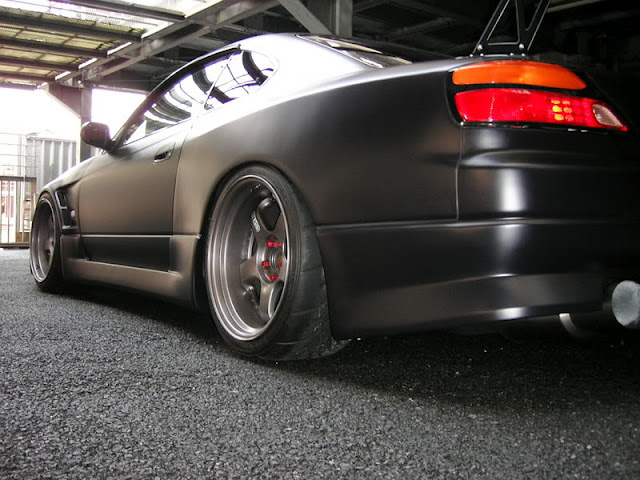
RAUH WELT S15 >> Car Spotlight like BOSS

Need to create something unique, Nakai-san was in charge of the look of this Silvia and let me tell you this is the best S15 i came accross. The simplicity with its RWB influence is such a beatiful mix.

  First off the new body panels were chosen, parts that would later be slightly modified and adapted to create a totally bespoke look. Wider rear fenders and rear bumper, which were all smoothed into the rest of the bodywork.
   This no-frills paint-job gives the whole car a very aggressive look and the color looks good under the sun. Masuda-san added that it's very easy to keep clean, since waxing isn't necessary. The car was then finished off with a Voltex rear GT Wing that helps keep those rear semi-slicks planted on the ground. SSR Professor SP-1s were chosen for a true race car feel while a combination of Yokohama and Bridgestone S-tires were used.

Specs: Rauh-Welt Nissan Silvia S15 (400+bhp)
Ported and polished head
Tomei Poncam Type-R Camshafts
Tomei rocker arm stoppers
N15 Pulsar throttle body
Trust 1.2mm metal head gasket
Trust T518 turbine
GP Sports exhaust manifold
Yashio Factory turbo outlet
Moonface MF-R EX Chamber
Custom titanium exhaust system
Custom air con condenser
Blitz LM Intercooler
Power steering cooler
HKS Oil cooler
HKS Oil filter relocation kit
Yashio Factory radiator
Trust air separator tank
Trust large capacity oil pan
HKS Air cleaner
HKS Suction pipe
HPI Engine Damper
Oil catch tank
740cc injectors x 4
Nismo fuel pump
Custom built fuel collector tank
Billion low-temperature thermostat
NGK racing plugs
Nismo engine mounts
HKS ECU

Drivetrain
Nismo transmission mounts
Nissan S14 5-speed transmission
OS Giken twin plate clutch
Nismo meshed clutch line
Shorter final gear
Nismo GT LSD pro TT model (2-Way)


Suspension
Fully adjustable Öhlins PCV suspension kit
Pillow tension rods
Adjustable rear upper ar
ms Rear member spacer
Custom under guard
Front Brembo 4-pot F50 calipers with ø340mm disc
Rear Nissan 2-pot calipers with original disc
Endless MA11 front pads, Endless CC-R rear pads
BNR34 GT-R brake master cylinder

Exterior
Rauh-Welt custom kit:
T&E front bumper
Ings wide front fenders
Ings side skirts
M Sports wide rear fenders
M Sports rear bumper
Border carbon bonnet
Voltex GT Wing
Custom matte black paint job

InteriorBride R LowMax driver seat
Bride L Brix passenger seat
Nardi steering wheel
Double boss
Billion VFC Max water temperature gauge andfan controller
Defi Oil pressure meter
Defi Control Unit II
Monster/HKS Lap Timer
Blitz SBC-iD Boost Controller
Blitz FATT DCII turbo timer
Custom billet gear knob
Carrozzeria MD/CD head unit

Wheels/TiresSSR Professor SP-1 18x9.5 (front), 18x10.5 (rear)
Yokohama Advan A048 225/40/18 (front), Bridgestone Potenza RE540S 265/35/18 (rear)